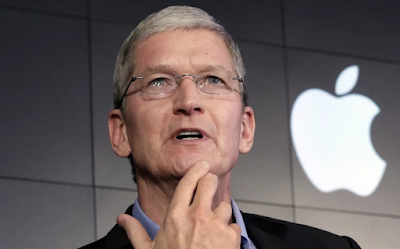
Icahn has sold his shares in the company over concerns at China’s influence on its stock price
Billionaire activist investor Carl Icahn says he had sold his entire stake in Apple Inc, citing the risk of China’s influence on the stock.
In an interview with US cable television network CNBC on Thursday, Icahn also said he was “still very cautious” on the US stock market and there would be a “day of reckoning” unless there was some sort of fiscal stimulus.
Icahn had been a huge cheerleader of Apple, acquiring a stake in the company almost three years ago, repeatedly calling the investment a “no brainer.”
In an open letter to Apple chief executive Tim Cook in May 2015, Icahn had argued that shares of the iPhone maker were worth $240 (£164), about 90% more than they had been trading. At $240 a share, Apple’s market cap would be $1.4tn, Icahn asserted.
But Icahn, who owned 45.8m Apple shares at the end of last year, said China’s economic slowdown and worries about how China could become more prohibitive in doing business triggered his decision to exit his position entirely.
Published By - Theguardian.com - Sports New, LifeStyle News, Politics news, UK and world political comment and analysis: Friday 29 April 2016 01.13 BST
View the latest news and breaking news today for U.S., world, weather, entertainment, politics and health at theNews Linzer
Showing posts with label Technology. Show all posts
Friday, April 29, 2016
Thursday, April 28, 2016
Zuckerberg has given Facebook investors all they need. He wants one thing in return: control
Company is likely to let its co-founder and CEO push that little bit further, given that it’s making more money, from more users
Mark Zuckerberg has dominated the desktop internet. He’s dominated the mobile internet. Now he’s going to dominate Facebook itself, and the company is probably going to let him.
The big news that came out of Facebook’s quarterly earnings report is that the company is making more money, from more users, being shown more adverts – and more profitable adverts at that.
The numbers are, well, big. Its userbase grew from 1.44 billion to 1.65 billion. Once upon a time, the number of people on Facebook grew fivefold over the course of a single year; it can’t do that anymore, because there aren’t enough people on the Earth.
It can’t even double any more, because there aren’t enough people with internet access. Which lends some necessary context to the company’s philanthropic efforts to push low-cost connections to the developing world through its Internet.org program.
Published By - Theguardian.com - Sports New, LifeStyle News, Politics news, UK and world political comment and analysis: Thursday 28 April 2016 11.17 BST
Mark Zuckerberg has dominated the desktop internet. He’s dominated the mobile internet. Now he’s going to dominate Facebook itself, and the company is probably going to let him.
The big news that came out of Facebook’s quarterly earnings report is that the company is making more money, from more users, being shown more adverts – and more profitable adverts at that.
The numbers are, well, big. Its userbase grew from 1.44 billion to 1.65 billion. Once upon a time, the number of people on Facebook grew fivefold over the course of a single year; it can’t do that anymore, because there aren’t enough people on the Earth.
It can’t even double any more, because there aren’t enough people with internet access. Which lends some necessary context to the company’s philanthropic efforts to push low-cost connections to the developing world through its Internet.org program.
Published By - Theguardian.com - Sports New, LifeStyle News, Politics news, UK and world political comment and analysis: Thursday 28 April 2016 11.17 BST
Sunday, April 24, 2016
How Facebook plans to take over the world
Social network went from digital directory for college kids to communications behemoth – and it’s planning for prosperity with its global takeover
It’s late afternoon on a blustery spring day on the waterfront at San Francisco’s Fort Mason, a former military base that’s now hired out for corporate functions. Vast warehouses, once used to store army supplies, are awash with sleek signs, shimmering lights and endless snacks. Behind them is an Instagram-ready view of Alcatraz island. In front, a fleet of Uber and Lyft cars lines up in the car park, while inside one of the warehouses Scottish synthpop band Chvrches take the stage.
For the first few songs there’s only a small group of hardcore vocal fans at the front of the stage, flanked by a subdued mix of backpack-wearing dad types politely bobbing their heads, drinking cocktails out of plastic cups.
The shindig has been put on by Facebook for the benefit of delegates attending its F8 conference. The event, which has run most years since 2007, began as a means to win over the developer community and has now become a comprehensive and highly engineered launchpad for the company’s annual plans. Many of the 2,600 attendees have paid $595 to find out how they can integrate their own digital products with Facebook to carve out some kind of presence among its enormous audience – and there’s booze and entertainment thrown in.
Olivia Solon in San Francisco
Published By - Theguardian.com - Sports New, LifeStyle News, Politics news, UK and world political comment and analysis: Saturday 23 April 2016 12.00 BST
It’s late afternoon on a blustery spring day on the waterfront at San Francisco’s Fort Mason, a former military base that’s now hired out for corporate functions. Vast warehouses, once used to store army supplies, are awash with sleek signs, shimmering lights and endless snacks. Behind them is an Instagram-ready view of Alcatraz island. In front, a fleet of Uber and Lyft cars lines up in the car park, while inside one of the warehouses Scottish synthpop band Chvrches take the stage.
For the first few songs there’s only a small group of hardcore vocal fans at the front of the stage, flanked by a subdued mix of backpack-wearing dad types politely bobbing their heads, drinking cocktails out of plastic cups.
The shindig has been put on by Facebook for the benefit of delegates attending its F8 conference. The event, which has run most years since 2007, began as a means to win over the developer community and has now become a comprehensive and highly engineered launchpad for the company’s annual plans. Many of the 2,600 attendees have paid $595 to find out how they can integrate their own digital products with Facebook to carve out some kind of presence among its enormous audience – and there’s booze and entertainment thrown in.
Olivia Solon in San Francisco
Published By - Theguardian.com - Sports New, LifeStyle News, Politics news, UK and world political comment and analysis: Saturday 23 April 2016 12.00 BST
Saturday, April 23, 2016
How do we make the Guardian a better place for conversation?
Online abuse pollutes the water in which we all swim. As the Guardian’s first female editor, it is important to me that we tackle it
Last year, a few weeks before I started as the new editor-in-chief of the Guardian, I read a review in the New York Times of Jon Ronson’s So You’ve Been Publicly Shamed. The book looks at the emergence of public humiliations on social media, and the review ended by saying that “the actual problem is that none of the men running those bazillion-dollar internet companies can think of one single thing to do about all the men who send women death threats”. Since I was about to become the first woman to run the Guardian (not, sad to say, a bazillion-dollar internet company), I decided that I had a responsibility to try to do something about it.
That’s why, over the past two weeks, the Guardian has published a series of articles looking at online abuse, with more to follow in the coming months. You might have read our interview with Monica Lewinsky in which she described the trauma of being subjected to what could be called the first great internet shaming, and how she still has to think of the consequences of talking about her past – whether by misspeaking, she could trigger a whole new round of abuse.
Last year, a few weeks before I started as the new editor-in-chief of the Guardian, I read a review in the New York Times of Jon Ronson’s So You’ve Been Publicly Shamed. The book looks at the emergence of public humiliations on social media, and the review ended by saying that “the actual problem is that none of the men running those bazillion-dollar internet companies can think of one single thing to do about all the men who send women death threats”. Since I was about to become the first woman to run the Guardian (not, sad to say, a bazillion-dollar internet company), I decided that I had a responsibility to try to do something about it.
That’s why, over the past two weeks, the Guardian has published a series of articles looking at online abuse, with more to follow in the coming months. You might have read our interview with Monica Lewinsky in which she described the trauma of being subjected to what could be called the first great internet shaming, and how she still has to think of the consequences of talking about her past – whether by misspeaking, she could trigger a whole new round of abuse.
A card-carrying fan of contactless, I'm now contactless-less – and it's not fun
In the first half of 2015, £2.5bn was spent in the UK using contactless cards. I’ve lost mine, and I’m now living life in the slow lane
Here is my problem. I have lost my debit card. This might seem like a minor hindrance. I haven’t, say, lost a limb. But I have lost the means to go about my everyday life as I usually would.
I rely on my contactless debit card as if it were a chip in my wrist. (And I don’t have a credit card, because I was always taught never to have credit cards.)
I use my contactless debit card for everything. When I encounter people who do not have contactless, I reel in horror. It’s almost as if they don’t have mobile phones. Or faces.
I get wildly irritated by shops and pubs that do not accept card payments, because it’s 2016. In supermarkets, if I have to use chip and pin, I can barely contain my fury. In a world in which being five minutes late to a tweet is considered embarrassingly tardy, it takes an awfully long time to use a chip and pin machine.
It has been estimated that contactless payment can halve the time it takes to pay with cash, but in my opinion, that’s a conservative estimate. Contactless is like swimming in liquid gold; cash is wading through treacle.
Published By - Theguardian.com - Sports New, LifeStyle News, Politics news, UK and world political comment and analysis: Friday 22 April 2016 15.28 BST
Here is my problem. I have lost my debit card. This might seem like a minor hindrance. I haven’t, say, lost a limb. But I have lost the means to go about my everyday life as I usually would.
I rely on my contactless debit card as if it were a chip in my wrist. (And I don’t have a credit card, because I was always taught never to have credit cards.)
I use my contactless debit card for everything. When I encounter people who do not have contactless, I reel in horror. It’s almost as if they don’t have mobile phones. Or faces.
I get wildly irritated by shops and pubs that do not accept card payments, because it’s 2016. In supermarkets, if I have to use chip and pin, I can barely contain my fury. In a world in which being five minutes late to a tweet is considered embarrassingly tardy, it takes an awfully long time to use a chip and pin machine.
It has been estimated that contactless payment can halve the time it takes to pay with cash, but in my opinion, that’s a conservative estimate. Contactless is like swimming in liquid gold; cash is wading through treacle.
Published By - Theguardian.com - Sports New, LifeStyle News, Politics news, UK and world political comment and analysis: Friday 22 April 2016 15.28 BST
Friday, April 22, 2016
From Uber to Eric Schmidt, tech is closer to the US government than you'd think
Twitter was scrabbling to defend the appointment of a Chinese head with government ties, yet US tech has a busy revolving door with its own government
What’s worse for a Silicon Valley executive: ties to the Chinese military or friends in the US Defense Department?
Twitter found itself confronting that question this week after it hired Kathy Chen, a former engineer for the People’s Liberation Army (PLA), to head up ad sales and business development in China, Hong Kong and Taiwan. Internet freedom activists and Chinese dissidents, who have to skirt Beijing’s digital censors to use Twitter, said it was a betrayal.
The spat illustrates the delicate balancing act technology companies face as they are forced to expand overseas to grow. In the US, Silicon Valley, like any industry, has embraced and relied on close relationships with former government officials both for technical talent and to help grease the wheels as they confront regulatory issues.
Alphabet’s executive chairman, Eric Schmidt, recently joined a Department of Defense advisory panel. Facebook recently hired a former director at the US military’s research lab, Darpa. Uber employs Barack Obama’s former campaign manager David Plouffe and Amazon.com tapped his former spokesman Jay Carney.
Published By - Theguardian.com - Sports New, LifeStyle News, Politics news, UK and world political comment and analysis: Thursday 21 April 2016 19.47 BST
What’s worse for a Silicon Valley executive: ties to the Chinese military or friends in the US Defense Department?
Twitter found itself confronting that question this week after it hired Kathy Chen, a former engineer for the People’s Liberation Army (PLA), to head up ad sales and business development in China, Hong Kong and Taiwan. Internet freedom activists and Chinese dissidents, who have to skirt Beijing’s digital censors to use Twitter, said it was a betrayal.
The spat illustrates the delicate balancing act technology companies face as they are forced to expand overseas to grow. In the US, Silicon Valley, like any industry, has embraced and relied on close relationships with former government officials both for technical talent and to help grease the wheels as they confront regulatory issues.
Alphabet’s executive chairman, Eric Schmidt, recently joined a Department of Defense advisory panel. Facebook recently hired a former director at the US military’s research lab, Darpa. Uber employs Barack Obama’s former campaign manager David Plouffe and Amazon.com tapped his former spokesman Jay Carney.
Published By - Theguardian.com - Sports New, LifeStyle News, Politics news, UK and world political comment and analysis: Thursday 21 April 2016 19.47 BST
Thursday, April 21, 2016
Is Apple's next product an electric car?
Apple has hired ex-Tesla engineer and opened R&D base in Germany, but reports suggest first versions of long-rumoured vehicle won’t be self-driving
Apple’s not-so-secret project to build an electric car is heating up, according to media reports, with the company poaching an expert from rivals Tesla. It has also opened an R&D office in Germany, home to some of the world’s most important luxury car manufacturers.
Industry site Electrek reports that Chris Porritt, a British car designer who worked at Aston Martin until he left in 2013 to become the vice-president of vehicle engineering at Tesla Motors, has been hired by Apple to work on the company’s Project Titan – just a few months after the executive believed to have been running the project, Steve Zadesky, left the company.
While Porritt, who quit Tesla in September 2015, is one of many former Tesla engineers employed in Cupertino, he’s one of the only senior managers to have made the jump. The timing of his departure coincides with comments made by Elon Musk in October 2015, when he referred to Apple as a “Tesla Graveyard”.
Published By -Theguardian.com - LifeStyle News, Politics news, UK and world political commentand analysis: Thursday 21 April 2016 11.05 BST
Apple’s not-so-secret project to build an electric car is heating up, according to media reports, with the company poaching an expert from rivals Tesla. It has also opened an R&D office in Germany, home to some of the world’s most important luxury car manufacturers.
Industry site Electrek reports that Chris Porritt, a British car designer who worked at Aston Martin until he left in 2013 to become the vice-president of vehicle engineering at Tesla Motors, has been hired by Apple to work on the company’s Project Titan – just a few months after the executive believed to have been running the project, Steve Zadesky, left the company.
While Porritt, who quit Tesla in September 2015, is one of many former Tesla engineers employed in Cupertino, he’s one of the only senior managers to have made the jump. The timing of his departure coincides with comments made by Elon Musk in October 2015, when he referred to Apple as a “Tesla Graveyard”.
Published By -Theguardian.com - LifeStyle News, Politics news, UK and world political commentand analysis: Thursday 21 April 2016 11.05 BST
Subscribe to:
Posts (Atom)
Featured post
Marvel executive says emphasis on diversity may have alienated readers
Marvel’s vice president of sales has blamed declining comic-book sales on the studio’s efforts to increase diversity and female char...
-
He said that a half dozen of its engineers are working to help a Brazil track the Zika virus and mosquito that spreads it's by doing one...
-
'Magic Mushrooms' May Permanently Alter Personality By Stephanie Pappas, Live Science Contributor Just one strong dose of ha...
-
Mesothelioma Survival rates are often be used by doctors as a standard way of discussing a person’s prognosis (outlook). Many people want t...